

Alchemical Elixir: The Black Dragon of Antimony
An Interview with Benjamin Turale


In my latest interview, I sit down with accomplished alchemist Benjamin Turale, who has specialised in working with stibnite/antimony. Over the course of an hour, we cover a wide range of topics, diving into both the laboratory techniques and the rich mythology surrounding this fascinating material.
Interestingly, antimony (Anjana) receives surprisingly little attention as a medicinal substance in Rasa Shastra, the Indian alchemical tradition.
If you enjoy these interviews, then please consider supporting my efforts by - ‘Buying Me A Coffee.’ It makes a huge difference, thank you!
Though classified as an Uparasa, alongside associated minerals like Haritala and Manashila (yellow and red arsenic), its documented medicinal uses remain remarkably limited. Note: Anjana translates to “eye remedy,” typically referring to a collyrium.
Classical Indian texts typically list five distinct types of Anjana: three naturally occurring forms of its ore ie: Sauviranjana, Srotoanjana, and Nilanjana. The two plant-based preparations, Rasanjana, derived from Berberis root, and Pushpanjana, (possibly linked to the blue lotus). To complicate matters further, Pushpanjana is also associated with zinc oxide, a material also known for its eye-healing properties. Added to this, identification is compounded by the fact that medicinal markets often substitute Galena (lead sulphide) for Anjana.
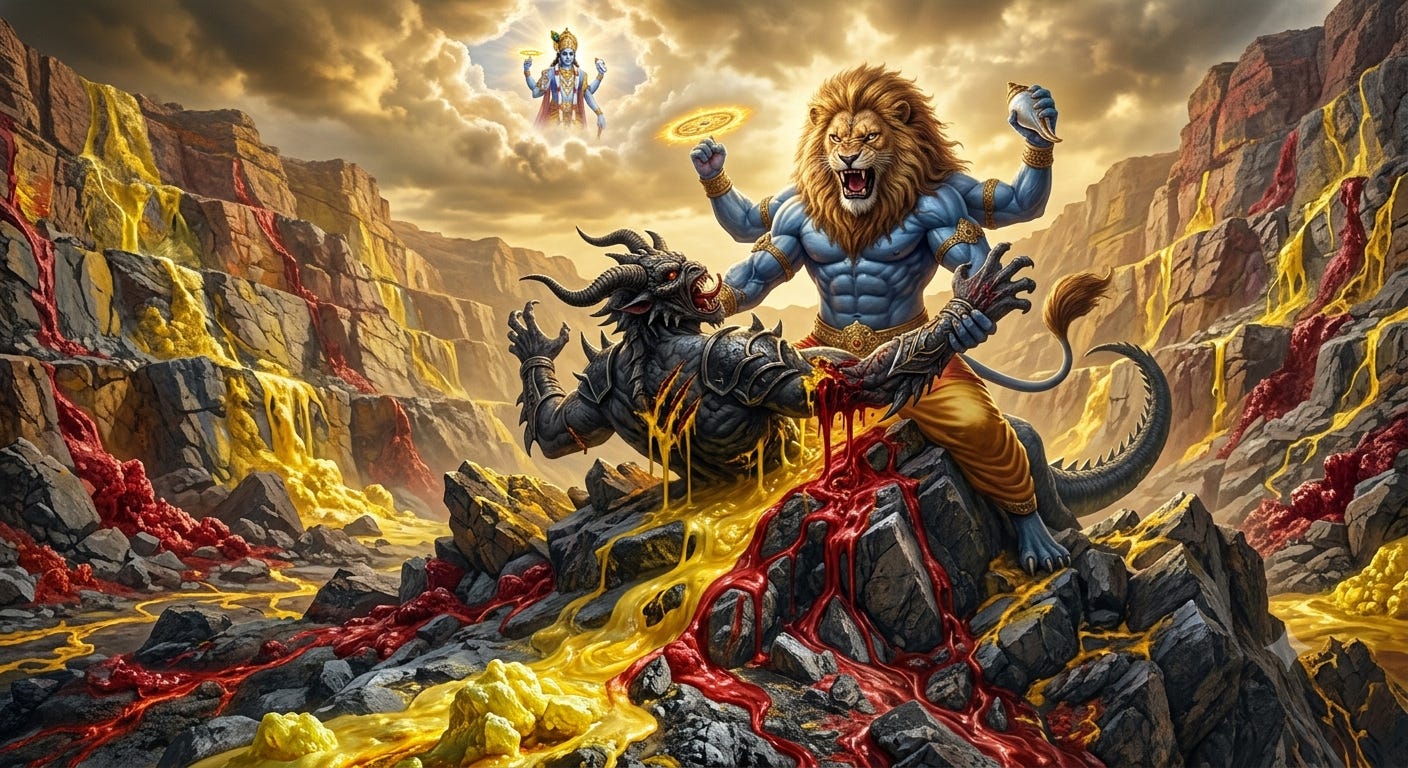
Death of Hiranyakashipu, by an avatar of Lord Vishnu called Narasinghe (man-lion)
In Rasa Shastra, texts such as the Rasa Ratna Samuccaya describe the origin of Haritala and Manashila are being tied to the mythic slaying of the demon king Hiranyakashipu by Narasimha, the half-man, half-lion. The latter is also an avatar of Lord Vishnu.
While Anjana isn't explicitly mentioned in this particular origin tale, it might be inferred to be part of the story, as it is an associated mineral, commonly found with arsenic. The attributes of each are outlined below.
Haritāla: Orpiment (As₂S₃), born from the vital yellow essence vomited during Hiranyakashipu’s death by Narasimha.
Manashila: Realgar (As₄S₄), a fiery, red-arsenic companion mineral, found in the same veins as Haritāla.
Añjana: Antimony/Stibnite (Sb₂S₃), a dark collyrium mineral as well as being associated in the same group of Uparasa materials.
Sharp & Penetrating Minerals
In Ayurvedic pharmacology, those minerals seen to be born from the wrath of Vishnu are considered to have a strong tikshna quality, that is - having a sharp and penetrating effect. This also explains their power to scrape away excess from bodily tissues (high Kapha), while gently clearing and cleansing the subtle channels of vision (aggravated by high Pitta).
While traditional kohl/kajjali (eye black) is generally linked to the goddess Kali, broader Indian folklore also connects these dark collyriums to cooling divine teardrops. In some accounts, the claws of the Vishnu avatar were washed in water, vision.
More about Benjamin and His Work:
In Benjamin’s own words:
I am the Director of the Temple of Mercury, a laboratory alchemist and teacher. I have entered and exited the Hermetic labyrinth, completing advanced studies in laboratory and spiritual alchemy in the continuing traditions of Frater Albertus, Robert Bartlett and Dennis William Hauck. My work has received the Paracelsus Award for outstanding contributions to alchemy. Whether I’m crafting metallic tinctures, extracting herbs, practising ceremonial magic or running workshops for the temple, every day I live and breathe the Hermetic current.
I proudly serve on the Board of the International Alchemy Guild (a not-for-profit charity) as Director of Education and also work to organise events like the 2018 Alchemy Conference and the recent 2022 Alchemy Conference. I’ve also presented at numerous occult conferences. I create projects where people from different branches of the western mysteries can come together and share in its rich spiritual tradition. I also work to help preserve and pass on the Albertian Alchemical lineage.
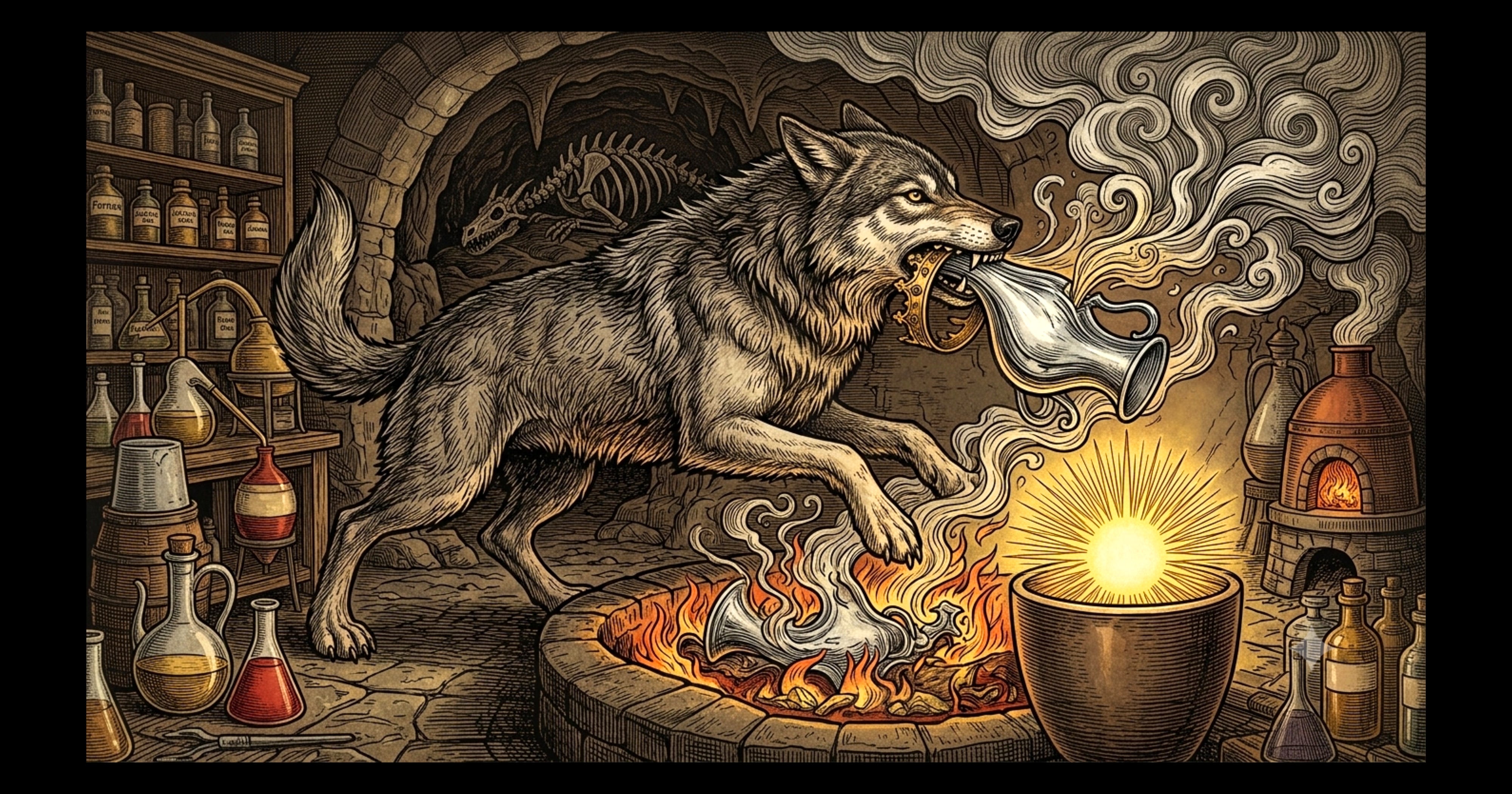
Antimony - in its devouring wolf form
I worked for over 15 years as a transpersonal psychotherapist, counselling supervisor and university lecturer. For my masters degree I authored a scientific study on altered states of consciousness. I have been employed as a teacher in one way or another since 2007. I am a lifelong musician, having been initiated as a bard into the college of Ynis Witrin (Glastonbury, UK) in 2018. I have also deeply explored Buddhist meditation practice since 2007 and done several long retreat intensives.
My teaching philosophy is focused on experiential pedagogy, meaning that I like my students to learn through practice, reflection and application of theory, rather than just theory alone. I also believe that people develop and change through this model and it is the most effective way, through holistically engaging learners, to instil confidence and competence.
USEFUL LINKS:
Email: templeofmercury@gmail.com